A patient called your practice last week with a new symptom. They were not sure if it was really serious. They didn’t know whether they should come to you, schedule for later, or manage it at home only. They just needed a person to help them think through it.
What happened after this determined whether that patient still thinks of your medical practice as the place they call when something comes up. Or whether they have already started looking elsewhere. To another practice.
A telehealth virtual assistant for triage is what makes sure that call goes right. Every time. Here’s why that is so important from a patient retention perspective.
What Is a Telehealth Virtual Assistant for Triage?
A telehealth virtual assistant for triage is a rigorously trained professional who handles all patient calls remotely. They guide them to the appropriate level of care based on what they are experiencing.
They answer the call and listen to what the patient is really describing. They also ask structured questions that help them assess the urgency within established clinical protocols. Then they make a routing decision. Does this patient need to be seen today? Can they wait for a scheduled appointment? Can their specific concern be addressed with just clear self-care guidance over the phone?
This is not a clinical diagnosis at all. It’s a structured nd protocol-driven process. One that makes sure every patient who calls your practice gets a response that matches what they really need. A real, personalized, and fully informed response that routes the patient correctly.
When this process is working well, the patient experience improves immediately. They called you. A professional answered and helped them. They now know what to do next. And they feel really cared for rather than managed.
How Virtual Triage Reduces Unnecessary Visits
This is something that’s really important for the patient experience and for your practice’s operational efficiency.
According to Wikipedia, telehealth is when doctors use technology like phones and video to help patients. This includes giving health advice over the phone when someone calls with a concern. Verywell Health is a well-known health website that helps millions of people understand their health better. According to it, telehealth has made it easier for patients to get care when they need it. When patients can call and talk to a real professional who guides them, they feel more confident about their health. And that confidence keeps them coming back to your practice.
A Health Care Home study found that about 40% of patient same-day appointment requests can be resolved just over the phone, with 90% of those resolved calls being advice-only situations where the patient didn’t need to come in at all.
Nearly half of the patients calling to request a same-day appointment don’t really need a same-day appointment. They just need information. They need reassurance. They need someone to tell them clearly what to watch for and when to call the practice back.
Without triage, all of those patients just default to an appointment. The schedule fills with visits that could have been just calls. The waiting room gets crowded this way. The clinical team gets stretched further, and the patients who genuinely need to be seen in person may have to wait longer than they should.
With proper triage, only the right patients get same-day slots. The ones who need advice get it immediately, without an unnecessary visit. And the patients who just needed their question answered feel just as cared for as the ones who came to you. Because they got a real answer from a real person in real time.
This directly improves the experience for everyone. The patient who was really worried and got clear guidance feels taken care of. The patient who needed an urgent appointment got one without fighting for a slot in a full schedule. And your clinical team is just seeing the patients they actually need to see.
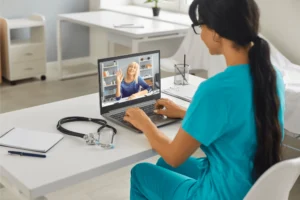
Telehealth Virtual Assistant for Triage
Supporting Patients 24/7
Worry doesn’t keep any business hours. A symptom that shows up on a Friday afternoon doesn’t wait until Monday morning to cause anxiety. A patient who woke up in the night with feeling something wrong doesn’t want to wait hours for your office to open before they can reach anyone.
A study of EBO’s virtual assistants found that around 42% of patient conversations occur outside regular office hours. That means nearly half of all patient interactions happen when the practice is fully closed. That’s a significant portion of patient communication that most practices are currently not capturing at all.
A telehealth virtual assistant for triage provides full coverage even when your office is closed. Evenings. Weekends. The times when patients are most likely to sit with a concern unaddressed.
When your patients know they can reach someone at your practice around the clock, the anxiety of not knowing what to do goes down so much. Also, the likelihood of an unnecessary ER visit goes down. And the sense that your practice is really there for them, not just during the hours when it’s convenient for the practice, goes up a lot.
That kind of 24/7 availability is not just any service feature. It’s a proper retention tool. Patients who feel supported at any hour are patients who don’t go looking for practices that offer them better access.
Provma provides dedicated telehealth virtual assistants trained specifically in triage protocols. They answer all your calls, assess patient needs with well-structured questions, escalate any urgent concerns immediately, and route patients to the appropriate level of care. All this happens within a fully HIPAA-compliant system. Your patients get real help when they need it. And your practice becomes the one they always call first.
Conclusion
Patient retention is not just one big decision. It’s the accumulation of many small experiences. The call that got answered on time. The concern that really got addressed. The patient who felt heard even at 9 pm on a Saturday and remembered that feeling the next time they needed any care.
A telehealth virtual assistant for triage is the system that makes all those experiences happen consistently. Every time a patient picks up the phone and reaches out to your medical practice.
That consistency is what patients stay for.
FAQs
What is a telehealth virtual assistant for triage?
A telehealth virtual assistant for triage is a remote professional who answers all patient calls, assesses their needs, and determines the appropriate level of care. They follow protocols to decide if a patient needs a same-day appointment, can wait, or can be managed with just advice over the phone.
How does virtual triage improve patient retention?
Virtual triage improves retention by ensuring every patient really gets a positive experience. Patients who feel fully heard and supported are more likely to stay with your practice. Triage is where that experience starts.
Can a virtual assistant handle urgent patient calls?
Yes. Virtual assistants are rigorously trained to identify any urgent concerns and escalate them to the clinical team immediately. They follow all protocols to ensure safe and consistent triage.
Does telehealth triage reduce unnecessary visits?
Yes. Research shows that around 40% of patient same-day appointment requests can be just resolved over the phone. About 90% of those are “advice only.” This reduces any unnecessary visits and improves patient experience.